


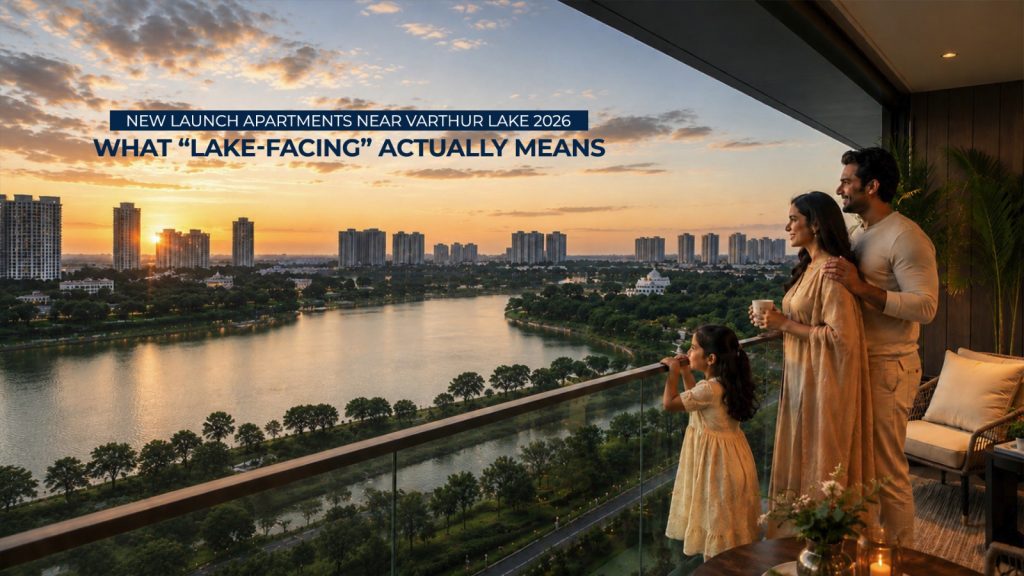
Quick answer: “Near Varthur Lake” and “lake-facing” are not the same claim. Proximity means the project sits within a certain distance of the lake — often 1-3 km in marketing use.
Lake-facing means a specific unit has an unobstructed line of sight to open water from its living area or bedroom. Always ask for the unit number, floor, and tower being shown before accepting either claim, and verify sightlines during a physical site visit, not from a rendered image.
Varthur Lake has become one of the most-used location anchors in Whitefield real estate marketing. That’s understandable — waterfront proximity is a genuine value driver almost everywhere in the world. But “near the lake” has been stretched to cover projects that are several kilometers away with no direct view at all. This guide gives you the exact questions to separate real lake-facing value from directional marketing.
The Three Different Claims Being Made
“Near Varthur Lake” (Proximity Claim)
This typically means the project is located within a broad radius of the lake — anywhere from a few hundred meters to 2-3 km. It says nothing about whether you can see the lake from your unit. Ask for the exact straight-line distance in kilometers, not “minutes away,”
which varies wildly with traffic and route.
“Lake View” (Partial or Angled View Claim)
This usually means some units in the project have a partial or angled view of the lake, often from higher floors or specific corners — not every unit, and not always full water frontage.
Ask specifically which towers, floors, and unit numbers qualify, and request to see the actual view from that specific unit, not a marketing render.
“Lake-Facing” / “Opposite the Lake” (Direct Line-of-Sight Claim)
This is the strongest and most specific claim: the project sits directly across from or immediately adjacent to the lake, with an unobstructed line of sight to open water from the unit itself. This is verifiable on a site visit and on satellite maps — you should be able to independently confirm this without relying on the builder’s description at all.
How to Verify Before You Book
- Check satellite view independently. Use Google Maps satellite view to measure the actual distance between the project’s plotted location and the lake boundary. This takes two minutes and cuts through most exaggeration immediately.
- Ask for the unit-specific view, not the project-level claim. A project can legitimately say “opposite Varthur Lake” as an address descriptor while only a subset of higher-floor, lake-side-facing units actually have the view. Always ask: does this specific unit have line-of-sight to the water?
- Visit at the time of day you’d actually be home. Renders are shot in ideal lighting. A genuine site visit during evening hours, when you’d realistically be relaxing at home, tells you far more about the actual view quality.
- Ask what’s between the unit and the lake. Trees, boundary walls, other under construction towers, or a service road can all block what would otherwise be a valid line of-sight. This detail rarely appears in brochures.
- Confirm whether the lake frontage is likely to change. Lake boundary and buffer zone regulations in Bangalore have shifted before. Check with the local development authority on any buffer-zone rules that could affect construction or view permanence near the specific water body.
Why This Matters Financially, Not Just Aesthetically
Lake-facing and lake-view units typically carry a real price premium — often a meaningful percentage over a non-facing unit in the same tower. If you’re paying that premium, you’re purchasing a specific, verifiable asset — not a marketing adjective. Confirming the actual line-of-sight before booking protects both your living experience and your resale value; a unit sold to you as “lake-facing” that isn’t will be a harder, more contested resale later.
Where Genuine Lake-Facing Positioning Exists
Some new launches on Varthur Road do sit directly across from the lake with genuinely unobstructed frontage — this isn’t universally exaggerated marketing. Tru Aquapolis is positioned directly opposite Varthur Lake on Varthur Road, with select 3 BHK and 4 BHK units offering direct line-of-sight to open water from living and master bedroom areas — verifiable on a site visit against the specific unit and floor.
Frequently Asked Questions
Q: What’s the difference between “near Varthur Lake” and “lake-facing”?
A: “Near” is a proximity claim describing distance from the project to the lake, often 1-3 km. “Lake facing” is a unit-specific claim describing an unobstructed line of sight to open water from a
particular apartment’s living or bedroom area.
Q: How can I verify a lake-facing claim before booking?
A: Cross-check the project’s plotted location against the lake boundary on satellite maps, ask for the specific unit number and floor being marketed as lake-facing, and physically visit that unit to confirm the sightline yourself.
Q: Do lake-facing units cost more?
A: Yes, typically. Lake-facing and lake-view units usually carry a price premium over otherwise identical units in the same tower without the view — which is why verifying the claim before paying that premium matters.
Q: Can lake views change over time due to construction or regulation?
A: Yes. Future construction on adjacent parcels, boundary or buffer-zone regulation changes, and vegetation growth can all affect a currently open view. Ask the developer about any known upcoming developments on adjacent land.